
TRP DH–R Evo vs TRP EVO Pro. The TRP DH-R Evo has earned a reputation as one of the best gravity brakes on the market, trusted by countless downhill and enduro riders. Now, TRP has released the EVO Pro, refining the original design with a redesigned lever, more adjustability and even more braking power.
So, should you upgrade, or is the original DH-R Evo still the better buy?
Quick Verdict
 Best Overall: TRP EVO Pro
 Best Value: TRP DH-R Evo
Buy the EVO Pro if you want:
More braking power
Better lever ergonomics
Tool-free bite point adjustment
Maximum performance
Buy the DH-R Evo if you want:
Nearly identical stopping power
Better value
A proven World Cup brake
To save money
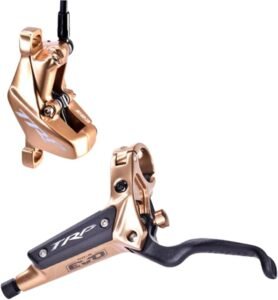
TRP DH-R Evo
Pros
Massive stopping power
Excellent modulation
Proven reliability
Easy bleeding
Lower price
Cons
Limited lever adjustment
No bite point adjustment
The DH-R Evo remains one of the most powerful brakes available and is still used by many aggressive trail, enduro and downhill riders. It delivers consistent braking with excellent modulation and has become known for its reliability.
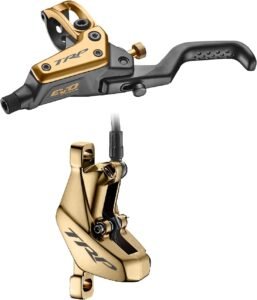
TRP EVO Pro
Pros
More powerful than the DH-R Evo
Completely redesigned lever
Tool-free Pad Activation Dial (PAD)
Wider reach adjustment
Improved ergonomics
Cons
Higher price
The EVO Pro keeps the proven four-piston caliper from the DH-R Evo but introduces an all-new lever designed to improve ergonomics and increase mechanical advantage. It also adds TRP’s Pad Activation Dial (PAD), allowing riders to adjust the bite point without tools.
Key Differences
Braking Power
Winner: EVO Pro
TRP redesigned the lever to generate more mechanical advantage while keeping the same caliper. The result is noticeably stronger braking with less finger effort.
Modulation
Winner: Tie
Both brakes offer outstanding modulation and predictable control.
If you enjoy feathering the brakes through technical sections, both are among the best available.
Lever Feel
Winner: EVO Pro
This is where the EVO Pro makes the biggest improvement.
Compared with the DH-R Evo, the new lever:
Feels more comfortable
Sits closer to the handlebar
Has a wider reach adjustment
Includes the Pad Activation Dial
Riders with smaller hands will notice the difference immediately.
Adjustability
Winner: EVO Pro
DH-R Evo:
Reach adjustment only
EVO Pro:
Reach adjustment
Pad Activation Dial (bite point adjustment)
The EVO Pro allows you to fine-tune exactly when the pads contact the rotor.
Heat Management
Winner: Tie
Both brakes use:
Four-piston calipers
Mineral oil
2.3mm rotors
High-flow caliper design
Heat management is excellent on both systems.
Value
Winner: DH-R Evo
Since the EVO Pro replaced it as TRP’s flagship brake, the DH-R Evo is often available at a lower price while still delivering excellent performance.
Specification Comparison
| Feature | TRP DH-R Evo | TRP EVO Pro |
|---|---|---|
| 4-Piston Caliper |  | |
| Mineral Oil | | |
| 2.3mm Rotor Compatible | | |
| Reach Adjustment | | |
| Bite Point Adjustment |  | |
| Redesigned Lever | | |
| Overall Power | Excellent | Outstanding |
Which Brake Should You Buy?
Choose the DH-R Evo if:
You want the best value.
You already own a set and are happy with them.
You don’t need extra lever adjustment.
Choose the EVO Pro if:
You’re buying new brakes.
You want the most refined TRP brake available.
You prefer a closer lever position.
You like being able to adjust the bite point.
Final Verdict
The TRP EVO Pro is the better brake overall thanks to its redesigned lever, increased power and improved adjustability. It builds on everything riders liked about the DH-R Evo while making the lever feel more comfortable and easier to tune.
However, the TRP DH-R Evo remains one of the best gravity brakes you can buy. If you already own a set, there is little reason to upgrade unless you specifically want the new lever features. If you’re shopping on a budget, the DH-R Evo continues to offer exceptional performance for the money.
Explore more Gear

Looking for more MTB gear recommendations? Check out our most popular guides below.